Overview
“The Bank remains unflinching in its commitment to reinforcing the environmental and social dimensions of its operations. These mutually reinforcing pillars are essential not only to the Bank’s credibility and accountability, but also to delivering inclusive growth and ensuring a just, resilient transition.” - Governor Carlo Monticelli
The CEB and Sustainability
The 2023-2027 Strategic Framework enables the CEB to assist its member states in meeting their social investment needs and effectively responding to escalating crises, with a view to strengthening Europe’s social fabric and prioritising support for vulnerable people.
The CEB aims to develop a cross-cutting approach to sustainability that rests on complying with ESG (environment, social and governance) criteria at corporate level; ensuring environmental and social safeguards at project level; addressing climate change with a people-centred focus; and contributing to the 2030 Agenda for Sustainable Development.
Managing Sustainability
Sustainability is embedded in all the CEB’s activities, from its core business to its internal operations, encompassing both the CEB’s own means and resources and its financing activities to promote social cohesion and serve vulnerable people. The CEB helps to lead the global effort towards a just and socially inclusive climate transition in its 43 member states.
At a strategic level, the CEB’s Strategic Framework 2023-2027, approved by the Governing Board, sets the mid-term vision for the Bank’s operations and is intrinsically linked to social and environmental sustainability. The Paris alignment framework, and accompanying roadmap, defines the Bank’s climate approach.
At the operational level, the CEB is strongly committed to fostering social and environmental sustainability both in its project financing (see the Environmental and Social Safeguards Policy) and in its internal operations (see the CEB Environmental Statement). The Public Information Policy describes the way the CEB discloses information by seeking to facilitate the widest possible access.
More specifically, sustainability topics that concern the CEB as a whole, e.g. reporting and disclosure, ESG ratings, stakeholder engagement, and coordination between directorates through an internal network of ESG correspondents, are dealt with by the Corporate Responsibility & ESG Reporting Unit.
The Environmental and Social Sustainability – Climate Change Unit ensures consistent implementation of the Bank’s Environmental and Social Safeguards policy.
Effective January 2026, a new Sustainability Working Group (SWG) oversees sustainability matters at the Bank, with a focus on reporting on CEB’s environmental, social and governance (ESG) dimensions. The SWG will also address any remaining issues previously dealt with by the Paris Alignment Working Group and Steering Committee, which have fulfilled most of their objectives.
Being accountable and transparent
The CEB commits to be transparent and accountable, and to conduct its business according to the highest standards of integrity and compliance.
In particular, the Office of the Chief Compliance Officer (OCCO) ensures that the prevention of money laundering, terrorist financing, harmful tax practices and the CEB’s commitment to high standards of integrity, ethics, anti-fraud and anti-corruption, are integrated into all phases of the Bank’s project cycle. Information security is a significant part of OCCO’s mandate, and is managed by the Chief Information Security Officer (CISO).
The CEB’s revamped Integrity and Compliance Policy, approved by the Administrative Council in January 2024, modernises the Bank’s compliance-related governance framework, aligning with international best practices and peers.
If you wish to raise an issue with OCCO, use: compliance@coebank.org or whistleblowing@coebank.org.
The Office of the Chief Compliance Officer also publishes an annual Integrity and Compliance Report.
Transparency and accountability are also ensured by regular public reporting and disclosure. Since 2009, the CEB has provided an annual account of its approach to sustainability. The Bank's overall contribution to socially and environmentally sustainable development is therefore reflected in the annual Sustainability Report and companion Global Reporting Initiative (GRI) Content Index, as well as in a Task Force on Climate-related Financial Disclosures (TCFD) Report.
In addition, there is dedicated reporting on the CEB’s Social Inclusion Bonds (including the Bonds’ link to the Sustainable Development Goals), and disclosure on lessons learnt from the Bank’s project monitoring and evaluation activities.
Stakeholder Engagement through a materiality assessment
The starting point for defining the Bank’s material sustainability topics is to assess the related risk and opportunities: how the CEB could be affected by sustainability issues, including from a financial perspective – and impacts: how the Bank impacts society, the environment and ultimately people’s lives, both constituting the CEB’s approach to ‘double materiality’.
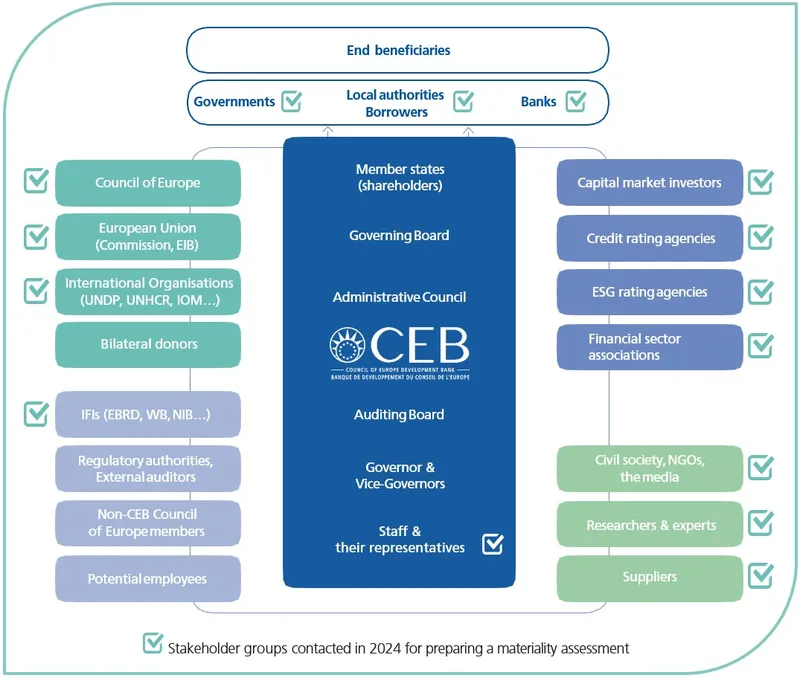
In 2024, the CEB performed a pilot to update its materiality assessment with dedicated stakeholder engagement that is linked to this exercise. The stakeholder groups contacted for preparing this pilot were:
Engagement through partnerships
Some examples of our engagement in 2025 were:
The CEB is a regular participant in the United Nations Climate Change Conferences (COP), such as Brazil.
The CEB hosted a high-level event dedicated exclusively to the social aspects of climate change, “A decade of the Paris Agreement”, organised with the French Ministry of Ecological Transition and as official part of the series of commemorations initiated by the United Nations Framework Convention on Climate Change (UNFCCC). For the sixth year in a row, the CEB ran its Award for Social Cohesion, to recognise organisations and projects that help to address pressing social issues and drive social cohesion in CEB member states.
For more on partnerships see also here.
In this section
Related publications
-

Sustainability Report 2025
Sustainability is at the heart of the CEB’s mission to strengthen social cohesion across Europe. The new report … Published: May 2026 Read -
GRI Report 2025
This annual report provides stakeholders, including environmental, social and governance (ESG) rating agencies and socially responsible investors, with … Published: May 2026 Read -

Task Force on Climate-related Financial Disclosures (TCFD) Report 2025
Climate action and social progress go hand in hand. The CEB views the global fight against climate change … Published: July 2026 Read